How to use this site?

Please click on the comments to see the right option from the choices given

Dear Medicos,
This site contains a comprehensive list of medical PG entrance questions asked in various PG entrance examination throughout India like AIIMS, AIPGEE, PGI CHANDIGARH, JIPMER, CMC VELLORE .... and various state entrance exams like KERALA, TAMIL NADU, KARNATAKA, DELHI .... and also private entrances like COMEDK, MANIPAL etc...


SEARCH THE WEB

Showing posts with label KERALA PSC 2011. Show all posts

20111129

KERALA PSC Answer key 2011


LECTURER (VARIOUS SUBJECTS)
MEDICAL EDUCATION DEPARTMENT
(CATEGORY NUMBER: 244/2011)
Date of Test: 24/11/2011
PROVISIONAL ANSWER KEY

Question booklet code:
   A B C D    A B C D
1 B D A C 51 A C A D
2 D A C B 52 C A D A
3 C C A D 53 B C A B
4 A C B D 54 A D A C
5 B A B A 55 B A B A
6 C A D C 56 C A B B
7 C B B B 57 C B D D
8 C B D A 58 D A C A
9 D C C A 59 B B C A
10 A B A B 60 A B A B
11 B C B B 61 B C B D
12 A D C C 62 A B B C
13 B B C B 63 D B C B
14 B B B B 64 B D D B
15 B B B C 65 D D B C
16 C C D D 66 D C C A
17 C D D C 67 C C A A
18 B B B C 68 A D C C
19 D D C C 69 C A A D
20 D A D A 70 A A D C
21 B B C B 71 B C A C
22 B D A A 72 C A B B
23 D C C D 73 A B C A
24 C B B B 74 A C B C
25 A D A D 75 C B A B
26 D B D A 76 B A C A
27 B C B B 77 C B C B
28 A D B D 78 B C B C
29 D A A D 79 B D B D
30 A A D B 80 D B D B
31 D B D C 81 B C D B
32 B D C A 82 C D B A
33 C B D B 83 C D B C
34 D C A C 84 D B A D
35 A C B A 85 A D C A
36 B D B D 86 D B C D
37 A C B D 87 A C D B
38 C A C B 88 B A D C
39 B A C B 89 C A C D
40 C B A C 90 D C A C
41 B B D C 91 B C C A
42 B D C B 92 C C A A
43 B B B D 93 A B B C
44 D C B B 94 C A A C
45 C B B B 95 A C D B
46 B C C D 96 B B C C
47 C C D A 97 B A B B
48 A B C C 98 A A C D
49 C D A B 99 D B A B
50 D A B C 100 C D B A
LECTURER (VARIOUS SUBJECTS)
MEDICAL EDUCATION DEPARTMENT
(CATEGORY NUMBER: 244/2011)

20111124

Erickon's Psychosocial Stages of Development


1Basic Trust vs. Mistrust0-1HopeDependency or Paranoia
-when the parents present consistent, adequate, and nurturing care, the child develops basic trust and realizes that people are dependable and the world can be a safe place. The child develops a sense of hope and confidence; this is a belief that things will work out well in the end-when the parents fail to provide these things, the child develops basic mistrust, resulting in depression, withdrawal, and maybe even paranoia
2Autonomy vs Shame & Doubt2-3WillObsessive/Impulsive or Avoidant
-if parents guide children gradually and firmly, praise and accept attempts to be independent, autonomy develops. The result will be a sense of will which helps us accomplish and build self-esteem as children and adults-if parents are too permissive, harsh, or demanding, the child can feel defeated, and experience extreme shame and doubt,and grow up to engage in neurotic attempts to regain feelings of control, power, and competency. This may take the form of obsessive behavior; if you follow all rules exactly then you will never be ashamed again. If the child is given no limits or guidance, the child can fail to gain any shame or doubt and be impulsive. Some is good, as it causes us to question the outcomes of our actions, and consider others' well-being. This may also result in Avoidance; if you never allow yourself to be close to others, they can never make you feel ashamed
3Initiative vs Guilt4-5PurposeConstricted or Antisocial/Narcissistic
-the child becomes curious about people and models adults. Erickson believed the child does attempt to possess the opposite sex parent and experience rivalry toward the same sex parent; however, a true Oedipal Complex only develops in very severe cases-if parents are understanding and supportive of a child's efforts to show initiative, the child develops purpose, and sets goals and acts in ways to reach them-if children are punished for attempts to show initiative, they are likely to develop a sense of guilt, which in excess can lead toinhibition. Too much purpose and no guilt can lead to ruthlessness; the person may achieve their goals without caring who they step on in the process
4Industry vs Inferiority6-12CompetencyHelplessness or Shallowness
-occurs during Latency, but Erickson did not think this was a rest period; the child begins school and must tame imagination and impulses, and please others. If adults support the child's efforts, a sense of competence develops-if caretakers do not support the child, feelings of inferiority are likely to develop. Too much inferiority, and inertia or helplessness occurs (underachievers). Too much competency and the child becomes an adult too fast, and develops either into a Histrionic or Shallow person
One way to divide Erikson's stages is into two groups of four -- the first four have to do with figuring out the world, the last four with figuring out yourself
5Identity vs Role Confusion13-19FidelityIdentity Diffusion or Fanaticism
-young adults attempt to develop identity and ideas about strengths, weaknesses, goals, occupations, sexual identity, and gender roles. Teens "try on" different identities, going through an identity crisis, and use their friends to reflect back to them. Marcia offers four resolutions: Identity Achievement (crises and commitment), Moratorium (crises and commitment later), Foreclosure (commitment without crises), and Identity Diffusion (no crises, no commitment)-if they resolve this crisis, they develop fidelity, "the ability to sustain loyalties freely pledged in spite of the inevitable contradictions of value systems" (can be friends with very different people)-if they fail to resolve the crisis, they develop identity diffusion; their sense of self is unstable and threatened; too little identity and they may join cults or hate groups, too much identity and they may show fanaticism
6Intimacy vs Isolation20-24LovePromiscuity or Exclusion
-intimacy is the ability to be close, loving, and vulnerable with romances and friends. It is based in part upon identity development, in that you have to know yourself to share it. The virtue gained here is love. Failure to develop intimacy can lead to promiscuity (getting too close too quick and not sustaining it), or exclusion (rejecting relationships and those who have them)
7Generativity vs Stagnation25-64CareStagnation or Overextension
-if you have a strong sense of creativity, success, and of having "made a mark" you develop generativity, and are concerned with the next generation; the virtue is called care, and represents connection to generations to come, and a love given without expectations of a specific return-adults that do not feel this develop a sense of stagnation, are self-absorbed, feel little connection to others, and generally offer little to society; too much stagnation can lead to rejectivity and a failure to feel any sense of meaning (the unresolved mid-life crises), and too much generativity leads to overextension (someone who has no time for themselves because they are so busy)
8Ego Integrity vs Despair65-?WisdomPresumption or Disdain


-this entails facing the ending of life, and accepting successes and failures, ageing, and loss. People develop ego integrity and accept their lives if they succeed, and develop a sense of wisdom a "detached concern with life itself in the face of death itself"-those who do not feel a sense of despair and dread their death; it's too late to change their lives (Ebenezer Scrooge justmanaged to avoid it) Too much wisdom leads to presumption, too much despair to a disdain for life

Palmer's point

Palmer's point (3 cm below the left costal margin in the mid-clavicular line) is used as an laparoscopic entry method for inserting Veeres needle.

De Lancy levels

DeLancey describes the anatomy of vaginal vault prolapse in terms of 3 levels of support 


  • Level I involves the support of the upper vagina and cervix or the vaginal cuff (in a woman who has undergone total hysterectomy) by the cardinal-uterosacral ligament complex.
  • Level II denotes the lateral support of the mid vagina to the arcus tendineus fascia pelvis (white line).
  • Level III is represented by the fusion of tissue along the base of the urethra and the distal rectovaginal septum to the perineal body.

Colon Cutoff Sign


The colon cutoff sign describes the abrupt termination of gas within the proximal colon at the level of the radiographic splenic flexure, usually with decompression of the distal colon.


Inflammatory exudate in acute pancreatitis that extends into the phrenicocolic ligament by directly spreading through the lateral attachment of the transverse mesocolon gives rise to this sign.

Infiltration of the phrenicocolic ligament results in functional spasm and/or mechanical narrowing of the splenic flexure at the level where the colon returns to the retroperitoneum.

This transition point, or cutoff, is further accentuated by distention of the intraperitoneal transverse colon from the focal adynamic ileus, which is also a result of the underlying inflammatory process. This appearance can mimic a true colonic obstruction.

Ponsetti method

Ignacio V. Ponseti can be credited with developing a comprehensive technique for treating congenital clubfoot in the 1940s. One of the major principles of this technique is the concept that the tissues of a newborn's foot, including tendons, ligaments, joint capsules, and certain bones, will yield to gentle manipulation and casting of the feet at weekly intervals. By applying this technique to clubfeet within the first few weeks of life, most clubfeet can be successfully corrected without the need for major reconstructive surgery.


The Ponseti Technique

The corrective process utilizing the Ponseti technique can be divided into two phases:
  • the treatment phase, during which time the deformity is corrected completely, and
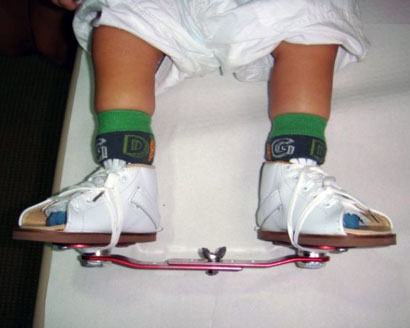
  • the maintenance phase, during which time a brace is utilized to prevent recurrence.
During each of these phases, attention to the details of the technique is essential to minimize the possibility of incomplete correction and recurrences.
  • The Treatment Phase
    The treatment phase should begin as early as possible, optimally within the first week of life. Gentle manipulation and casting is performed on a weekly basis. Each cast holds the foot in the corrected position, allowing it to gradually re-shape. Generally, five to six casts are required to fully correct the alignment of the foot and ankle. At the time of the final cast, the majority of infants (70% or higher) will require a percutaneous surgical procedure (with a small incision through the skin) to gain adequate lengthening of their Achilles tendon.
  • The Maintenance Phase
    The final cast remains in place for three weeks, after which the infant's foot is placed into a removable orthotic device. The orthosis is worn 23 hours per day for three months and then during the night-time for several years. Failure to use the orthosis correctly may result in recurrence of the clubfoot deformity. Good results have been demonstrated at multiple centers, and long-term results indicate that foot function is comparable with that of normal feet.

Ritgen manouvre

Delivery of a child's head by pressure on the perineum while controlling the speed of delivery by pressure with the other hand on the head