How to use this site?

Please click on the comments to see the right option from the choices given

Dear Medicos,
This site contains a comprehensive list of medical PG entrance questions asked in various PG entrance examination throughout India like AIIMS, AIPGEE, PGI CHANDIGARH, JIPMER, CMC VELLORE .... and various state entrance exams like KERALA, TAMIL NADU, KARNATAKA, DELHI .... and also private entrances like COMEDK, MANIPAL etc...


SEARCH THE WEB

Showing posts with label Embryology. Show all posts

20150619

Ligamentum teres develops from:

a. Umbilical artery
b. Umbilical vein
c. Ductus venosus
d. Portal radicles

20150617

Gartner's cyst arises from:

a. Remnant of paramesonephric duct
b. Remnant of mesonephric duct
c. Cervix
d. Vagina


Derivatives of Mesonephric duct:

 "Gardener's SEED" for 

Gartner's duct, 
Seminal vesicles,
Epididymis
Ejaculatory duct
Ductus deferens

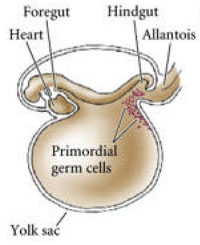
Primordial germ cell develops from:

a. Chorion
b. Amnion
c. Yolk sac
d. Cord blood


Ans. c) Yolk sac

20111017

Heterotaxy Syndromes


Situs ambiguous also known as heterotaxy, is a rare congenital defect in which the major visceral organs are distributed abnormally within the chest and abdomen.
The normal position of the organs is known as situs solitus.
Situs inversus is a condition in which the usual positions of the organs are reversed from left to right as a mirror image of the normal condition. 
If these are the two extreme positions on a continuum of asymmetric thoracic and abdominal organ formation, situs ambiguus covers everything in between.


Situs ambiguus or heterotaxy syndrome refers
to malposition and dysmorphism of thoracic and
abdominal organs associated with indeterminate
atrial arrangement and vascular anomalies.
Azygos or hemiazygos continuation of the IVC with
absence of the hepatic segment is the most frequent associated anomaly.


Right Isomerism or Asplenia or Ivemark's syndrome:

In this condition, bilateral right sidedness occurs. These patients have bilateral right atria, a centrally located liver , an absent spleen and both lungs have 3 lobes. The descending aorta and inferior vena cava are on the same side of the spleen.

Left Isomerism or Polysplenia syndrome:


Here, bilateral left sidedness occurs. These patients have bilateral left atria and multiple spleens, and both lungs have 2 lobes. Interruption of the inferior vena cava with azygous or hemiazygous continuation is often present.

Diaphragm- development

Diaphragm develops from the following components:

1. Septum transversum
2. Pleuroperitoneal membranes.
3. Ventral and dorsal mesenteries of esophagus.
4. Mesoderm of body wall.
5. Cervical myotomes.


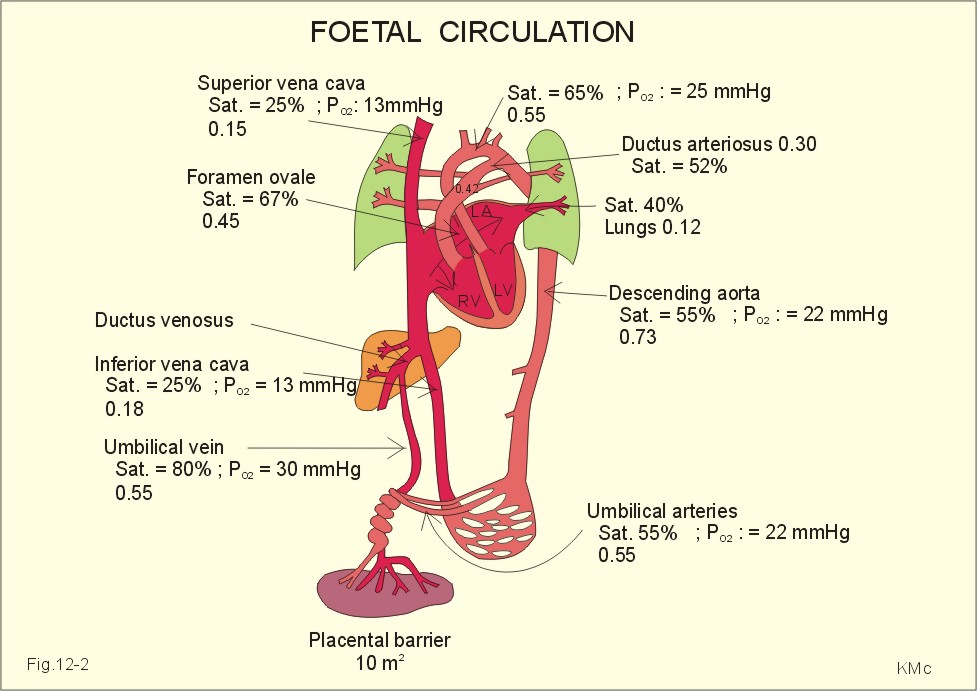
Foetal circulation

Percent saturation of foetal blood vessels

20111003

Neural Crest Derivatives


Connective tissue and bones of the face and skull
Cranial nerve ganglia
C cells of the thyroid gland
Conotruncal septum in the heart

Odontoblasts
Dermis in face and neck

Spinal (dorsal root) ganglia
Sympathetic chain and preaortic ganglia
Parasympathetic ganglia of the gastrointestinal tract
Adrenal medulla

Schwann cells
Glial cells
Arachnoid and pia mater (leptomeninges)
Melanocytes